Social Security Decisions You Only Get to Make Once — Get Them Right

Independent guidance for individuals and families in New Jersey and 12 other states. Clarity before coverage — and clarity before you claim.

Why Your Claiming Decision Matters More Than You Think

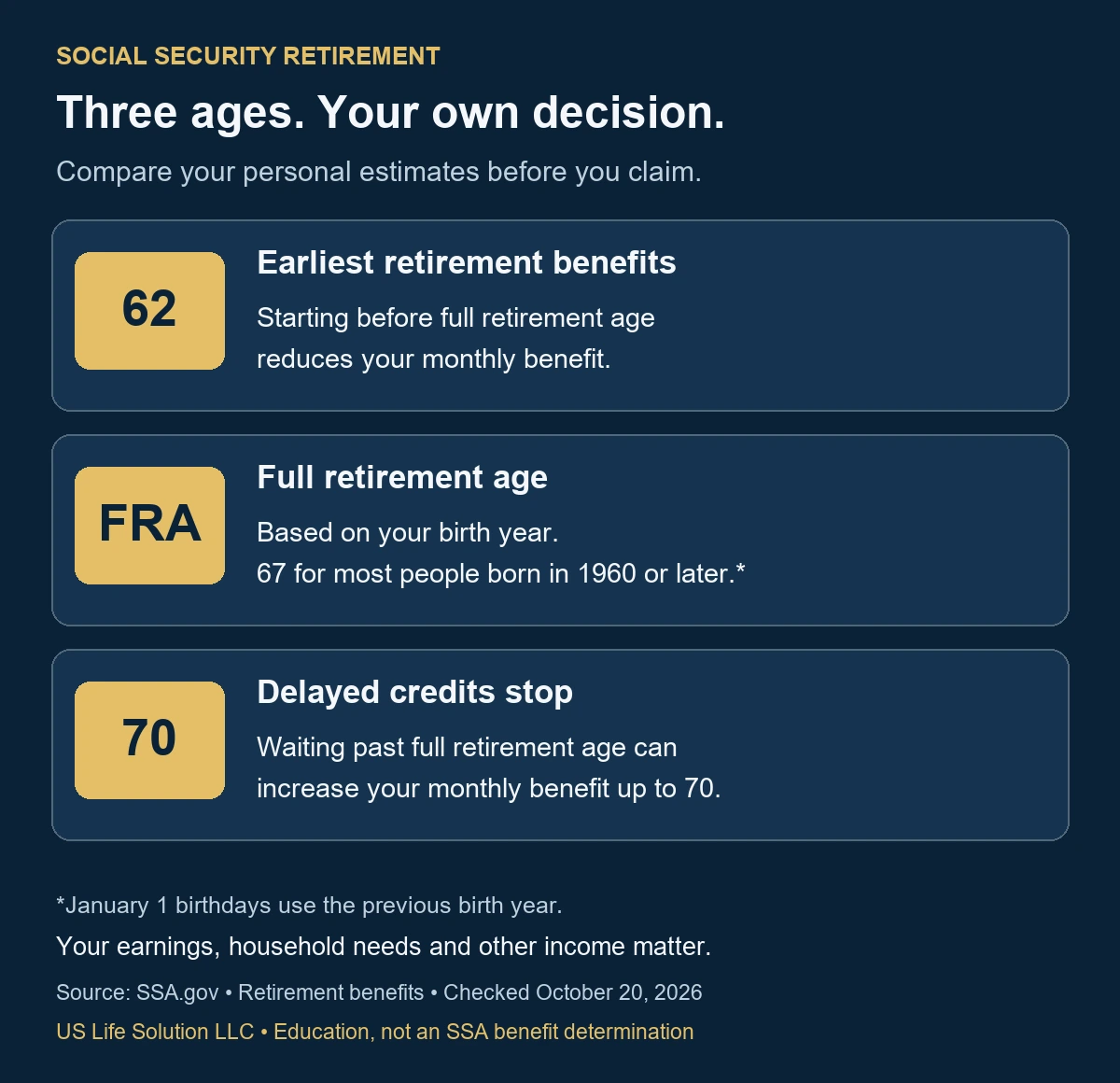
Social Security is the foundation of retirement income for most American households — yet it's one of the least understood decisions you'll ever make. The difference between claiming at 62 and waiting until 70 can exceed $2,200 per month for the same earnings record. For 2026, the maximum monthly benefit is $2,969 at age 62 and $5,181 at age 70, according to the Social Security Administration. Most people decide based on guesswork, a neighbor's advice, or whatever feels safest in the moment.

I'm Anil Khanchandani, founder of US Life Solutions, based in Secaucus, NJ. I help pre-retirees and retirees understand how Social Security actually works — the rules, the deadlines, the trade-offs — so the decision you make is an informed one, not a default one. I don't work for the Social Security Administration, and I'm not here to push a product. My role is education first: clarity before coverage.

Image: Replace Medicare-Solutions-scaled.jpg with a retirement/Social Security visual. Alt text: "Advisor explaining Social Security claiming options to a couple planning retirement."

Illustration showcasing coverage explanation from a Medicare consultant.

Social Security in 2026: The Numbers That Matter

These figures come directly from the Social Security Administration's 2026 announcements and are updated annually.

Cost-of-Living Adjustment (COLA) 2.8% Benefits rose 2.8% in January 2026
Average retired-worker benefit ~$2,071/month A baseline — your number depends on your record and claiming age
Maximum benefit at age 62 $2,969/month Early claiming permanently reduces your check
Maximum benefit at age 70 $5,181/month Delayed retirement credits add ~8% per year past full retirement age
Full Retirement Age (FRA) 67 (born 1960 or later) The pivot point for reductions and credits
Earnings limit (under FRA all year) $24,480 $1 withheld for every $2 earned above this if you work while collecting early
Earnings limit (year you reach FRA) $65,160 $1 withheld for every $3 above this, until the month you reach FRA
Maximum taxable earnings $184,500 Wages above this aren't taxed for Social Security — and don't increase your benefit

Source: Social Security Administration, 2026 Cost-of-Living Adjustment Fact Sheet (ssa.gov/cola). Figures change annually.

The 6 Most Common Social Security Mistakes — and How I Help You Avoid Them.

Claiming Too Early Without Running the Numbers

The problem: Nearly everyone is eligible at 62, and many claim the moment they can. But claiming at 62 with a full retirement age of 67 permanently reduces your benefit by about 30% — for life, and it reduces the survivor benefit your spouse may one day depend on.

How I help: Before you file, we map your break-even ages, health and longevity outlook, household income needs, and survivor implications side by side — so "earliest" and "best" aren't confused with each other.

Leaving spousal, survivor, or divorced-spouse benefits on the table

The problem: A lower-earning spouse may be entitled to up to 50% of the higher earner's full benefit. Widows and widowers can claim survivor benefits as early as 60. If you were married 10+ years and divorced, you may claim on your ex-spouse's record without affecting their benefit. Most people don't know which of these applies to them — and SSA staff won't proactively optimize for you.

How I help: I review your household as a unit — both records, both ages, both life expectancies — because the right strategy for a couple is almost never two individual decisions made separately.

Working while collecting and getting hit by the earnings test

The problem: If you collect before full retirement age and keep working, Social Security withholds $1 for every $2 you earn above $24,480 (2026). People are routinely blindsided by withheld checks or overpayment notices they're asked to repay.

The good news most people don't know: withheld amounts aren't lost forever — your benefit is recalculated at full retirement age. But the cash-flow surprise is real.

How I help: We project your earnings against the limit before you file, so you know exactly what to expect — or whether waiting a year or two changes everything.

Triggering avoidable taxes on your benefits

The problem: Up to 85% of your Social Security can become federally taxable once your "combined income" passes $34,000 (single) or $44,000 (married filing jointly) — and the thresholds start at just $25,000/$32,000. A poorly timed 401(k) withdrawal or rollover in the wrong year can push more of your benefit into taxable territory. O

ne bright spot for NJ residents: New Jersey does not tax Social Security benefits on the state return.

How I help: I coordinate your claiming timeline with your retirement account withdrawal strategy — see my 401(k) Rollovers and Retirement Strategies pages — so income lands in the right years. (I'm not a tax advisor; for tax filing decisions, I'll encourage you to confirm with your CPA.)

Ignoring the Social Security–Medicare connection

The problem: Social Security and Medicare are joined at the hip: Medicare Part B premiums are deducted from your Social Security check, higher income can trigger IRMAA surcharges on your premiums, and missing your Medicare enrollment window at 65 — because you delayed Social Security and assumed Medicare would wait too — can mean lifetime penalties.

How I help: This is where one-stop planning earns its keep. I'm a licensed Medicare strategist as well — your claiming age, Medicare enrollment, and premium exposure get planned together, not in silos. Start with my Medicare resource hub.

Outdated assumptions about pensions (WEP/GPO)

The problem: For decades, teachers, police, firefighters, and other public servants with non-covered pensions had benefits reduced by the Windfall Elimination Provision and Government Pension Offset. The Social Security Fairness Act, signed January 5, 2025, repealed both — and millions of affected retirees received adjusted payments. Yet many people are still planning around rules that no longer exist, or never went back to claim what they're now owed.

How I help: If you or your spouse have a government pension, we revisit your numbers under the current law — not the law you remember.

One Decision, One Chance, One Advisor Who Sees the Whole Picture

The Social Security Administration's employees are helpful, but they are prohibited from giving you advice about which claiming strategy is best for you. They'll process whatever you ask for — even if it costs your household six figures in lifetime income.

That gap is exactly what I'm building my practice to fill. I'm currently completing the Registered Social Security Analyst® (RSSA®) education program through the National Association of Registered Social Security Analysts (NARSSA) — a five-module curriculum covering benefits law, claiming strategies, tax provisions, and Medicare coordination. Upon certification, I'll use the RSSA Roadmap® analysis software to model your retirement, spousal, survivor, and divorced-spouse benefits across multiple claiming scenarios — a side-by-side, personalized report, not a generic calculator.

What makes this different from a standalone Social Security analysis: your claiming decision doesn't live in a vacuum. It interacts with your Medicare enrollment, your 401(k) and IRA withdrawals, your life insurance and estate liquidity, and your long-term care exposure. As an independent producer licensed in 13 states and representing 20+ nationally rated carriers, I can put all of those pieces on one table — defensive financial planning with Social Security as the foundation.

Image: Reuse our-services-29 advisor-meeting image or Anil headshot. Alt: "Anil Khanchandani reviewing a Social Security claiming analysis with clients in Secaucus, NJ."

Advisor meeting with smiling senior clients

Get Clarity Before You Claim

You get one chance to make this decision well. Before you file — or if you've recently filed and are within the 12-month withdrawal window — let's review your numbers together. The conversation is educational, pressure-free, and built around your situation, not a product.

Frequently Asked Questions About Social Security

US Life Solutions and Anil Khanchandani are not affiliated with, endorsed by, or connected with the Social Security Administration or any other U.S. government agency. This page is for educational purposes only and does not constitute legal, tax, or investment advice. Social Security figures shown are for 2026 and change annually; verify current amounts at ssa.gov. For decisions about your individual benefits, you may contact the Social Security Administration at 1-800-772-1213 or ssa.gov. Anil Khanchandani is an insurance-licensed professional in 13 states (CA License #4428939) and is currently completing the Registered Social Security Analyst® (RSSA®) education program; RSSA® and RSSA Roadmap® are registered trademarks of the National Association of Registered Social Security Analysts (NARSSA).